Global Corn Planting: An Overview of Key Regions
In 2024, global corn production reached approximately 1.27 billion metric tons. The United States produced around 386 million metric tons, making it the largest corn-producing country, contributing about one-third of the world’s total production.
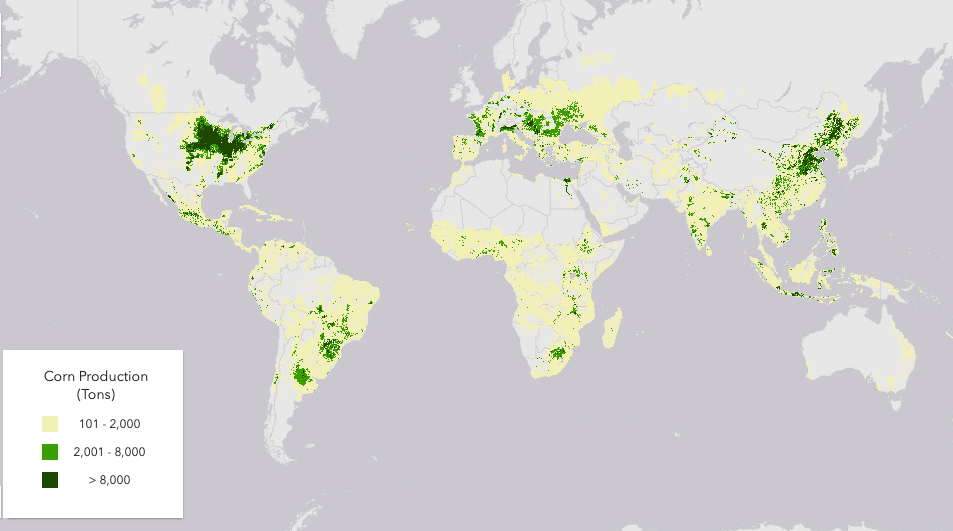
Source: USDA
Below is a list of the Top 10 corn-producing countries globally.
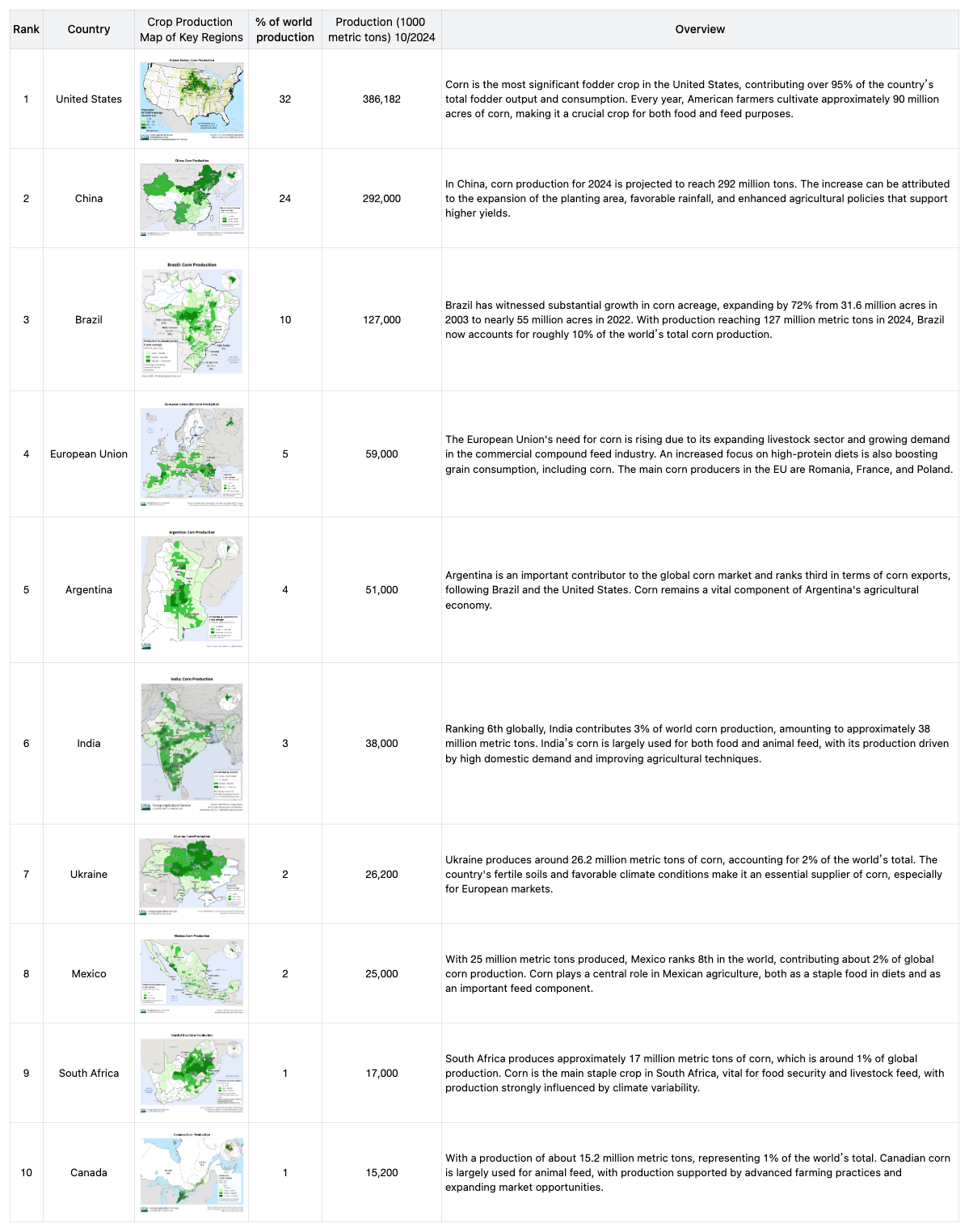
Compiled from: USDA
Understanding Corn Growth Stages and Challenges
Corn growth is divided into vegetative (V) and reproductive (R) stages, each with unique challenges. Proper timing of fertilizer, irrigation, cultivation, and pesticide applications is crucial to improving yields.
| Vegetative Stages | Reproductive Stages | ||
| VE (emergence) | Planting to Emergence: The seed germinates, and the seedling emerges above the soil. | R1 (silking) | Silking and Pollination Stage: The silks on the ear emerge, and pollination begins, determining the number of kernels. |
| V1 (first leaf) | The first true leaf is fully developed. | R2 (blister) | Grain Filling Stage: Kernels start to develop and fill, Kernels begin to accumulate liquid inside, appearing as a translucent blister. |
| V2 – V5 (2nd to fifth leaves) | Seedling Stage: A period of rapid growth characterized by the development of 2 to 5 leaves and initial root system establishment. | R3 (milk) | Kernels are filled with a milky substance. |
| V6 – V9 (6th to 9th leaves) | Jointing Stage: Stem nodes begin to elongate, leading to significant plant height increase. | R4 (dough) | The interior of the kernels becomes firmer, resembling dough. |
| V10 – V12 (10th to 12th leaves) | Pre-Tassel Stage: The plant enters a rapid growth phase, with increased leaf numbers and thickening of the stem. | R5 (dent) | The kernel surface shows dents as it starts to harden. |
| V(n) (nth leaf) | R6 (physiological maturity) | Maturity Stage: Kernels are fully matured, hardened, and develop a black layer at the base, indicating physiological maturity. | |
| VT (tasseling) | Tasseling Stage: The tassel is fully extended, and the plant reaches its maximum height. | ||

Knowing the growth stages and growth processes of corn allows growers to time field operations properly to meet windows of opportunity. Proper timing of fertilizer, irrigation, cultivation, harvest and pesticide application can improve yields significantly.
- Before VE: Burndown and pre-emergence herbicide spraying
- Early Growth (VE – V5): Post-emergence herbicide spraying is critical to control weeds.
- Tasseling (VT): Apply fungicides and insecticides to protect the crop.
- Reproductive (R1 – R5): Timely applications of nutrients and cover crop seeding can support grain development.
How Drone Spraying Achieves Precision in Corn Management
Traditional pest and disease management methods for corn are typically characterized by heavy chemical use, high labor costs, and terrain limitations. Tractors can cause up to 5% crop damage due to trampling, while manual labor is inconsistent and labor-intensive. Ground-based machinery struggles with accessing tall, dense corn during mid-to-late growth stages, leading to insufficient management of pests and diseases, ultimately affecting yields.
Aerial applications by airplanes or helicopters also have their limitations. They are not effective in small, irregularly shaped fields or areas with powerlines, where maneuverability is restricted. Similarly, tractors face challenges when fields are wet, as they may get stuck, and contribute to soil compaction, which hinders plant root development.

Drones overcome these limitations by offering precise, targeted applications of herbicides, fungicides, and fertilizers. They can operate in challenging conditions such as wet fields or irregular terrains and reduce chemical use by 30-40%. This approach minimizes crop damage and labor costs, enhancing productivity.
By overcoming the accessibility challenges associated with mid-to-late-stage corn, drones can reach areas that would be inaccessible to traditional equipment. This precision, combined with the ability to treat crops during critical growth phases, can boost yields by 10%.
Weed control
Effective weed control during the early stages of corn growth is crucial to prevent competition for nutrients and light, which can significantly impact yields. Drones offer a solution both before and after emergence. For pre-emergence weed control, drones can distribute herbicides evenly across the field, ensuring effective coverage without the soil compaction often caused by tractors. For post-emergence weed control, drones excel in targeting specific weed patches with high precision, significantly reducing herbicide use. This targeted approach not only cuts chemical costs but also minimizes the risk of harming emerging corn plants, leading to reduced chemical runoff and a smaller environmental footprint.

Insect Pest Control
Corn faces a variety of pests at different growth stages, each capable of significantly reducing yields if left untreated. Traditional methods often face limitations due to restricted access to fields or inconsistent application. Drones, however, offer a distinct advantage. With precise imaging capabilities, drones can identify pest hotspots and apply insecticides precisely where needed, reducing the overall volume of chemicals used while protecting beneficial species. This targeted pest control ensures effective intervention and reduces the risk of yield losses, particularly during the mid-to-late growth stages when pests such as corn borers and armyworms are most active.
Key Corn Pests in Major Production Countries
| Region | Top Pest | Control Timing | Traditional Treatment | Challenges | Drone Application | Benefits |
| United States | Corn rootworms | Early vegetative (V3-V6) | Tractor-mounted sprayers | Soil compaction, crop damage, inconsistent coverage | Targeted insecticide application | No soil disturbance, precise targeting, reduced chemical use |
| China | Asian corn borers | VT to R1 | Manual spraying | Labor-intensive, inefficient, delayed response | Imaging technology for hotspot detection | Quick detection, efficient treatment, labor savings |
| Brazil | Fall armyworms | Early vegetative (V3-V6) | Broad-spectrum pesticides | Harm to non-target species, overuse of chemicals | Precision targeting of infested areas | Preserves beneficial species, ensures early intervention |
| Europe | European corn borers | Late vegetative to VT | Tractor-based spraying | Soil compaction, lack of canopy penetration | Precise insecticide at VT | Improved pest control, no soil disturbance |
| South Africa | Stem borers | V6 to VT | Ground sprayers | Difficulty in reaching internal stem areas | Systemic pesticide delivery through drones | Effective internal pest management, systemic absorption |
Diseases Control
Diseases like gray leaf spot and common rust require timely intervention. Drones ensure fungicides are applied quickly and uniformly, preventing disease spread and protecting yields.
- Gray Leaf Spot: Typically occurs during the V10 stage and onwards. The disease reduces photosynthesis by causing lesions on leaves. Traditional management involves fungicide application with ground sprayers, which can damage plants at this critical growth stage. Drone spraying ensures that fungicides are applied uniformly without causing physical damage to the crop, thereby protecting the plant’s photosynthetic capability during key yield-determining phases.
- Northern Corn Leaf Blight: Often appears around the VT stage, affecting leaf integrity and ultimately reducing grain fill. Ground-based applications risk damaging the tall plants, while drones provide superior coverage, especially in dense fields, and can respond quickly as symptoms appear, preventing the spread of the blight.
- Common Rust: This disease typically manifests between V6 and VT stages, forming pustules on leaves that weaken the plant. Timely fungicide application is crucial, but traditional methods are often delayed due to wet field conditions. Drones, however, can fly over wet soils and apply fungicides immediately, providing timely protection and reducing potential yield losses.
Precision Nutrient Application
Corn’s nutrient demands peak during rapid growth stages. Drone-based foliar feeding during these times enhances nutrient uptake efficiently. Drones can apply nutrients uniformly to the most critical parts of the plant, which improves kernel development and increases yield. Research shows that using drones for foliar nutrient applications results in faster absorption and greater yield gains compared to ground sprayers, particularly in tall or dense fields.
Drones are also ideal for cover crop seeding after harvest, improving soil health and fertility for the next season. Cover crops help prevent soil erosion, fix nitrogen, and enhance organic matter, setting the stage for higher yields.

Why Drones are a Smart Investment for Corn Farmers
Drones can cover over 80 hectares per day—2-3 times faster than traditional sprayers—with just one or two operators. Their high level of automation, increasing ease of use, and versatility make drones an attractive tool for farmers seeking smarter, more sustainable practices. They are versatile tools that can spray, seed, and transport materials, making them a valuable asset for precision agriculture.

Still undecided about whether to use drones for corn management? Below is a detailed comparison of drones versus aircraft and tractors across various aspects of usage, aimed at helping you make a more informed decision.
Comparison between Drones, Aircraft and Tractors
| Aspect | Drones | Aircraft | Tractors |
|---|---|---|---|
| Precision Targeting | Highly precise with GPS and GIS technology, reducing chemical overlap and avoiding non-target areas | Moderate precision, affected by height and speed, harder to control in detail | Low precision, especially in irregular fields |
| Coverage Area | Best for small to medium fields, including irregular shapes. Can also manage large fields with coordinated drone fleets. | Ideal for large-scale fields, efficient coverage of vast areas | Suitable for small to medium fields; less efficient for very large areas |
| Maneuverability | Excellent, able to navigate tight or complex terrains, tree-lined edges | Poor in areas with powerlines or obstacles, cannot manage irregular shapes well | Limited, struggles with steep terrain or terraces |
| Flight/Operation Time | Battery limitations (12-30 minutes per charge) require frequent recharging or battery swaps | Can operate for several hours without interruption due to large fuel tanks | Long operation time but dependent on fuel and soil conditions |
| Payload Capacity | Limited capacity (a few gallons), requires frequent refilling for large areas | Large capacity (hundreds of gallons), less frequent refilling | Larger capacity but limited by the ability to traverse the field, especially in mud or wet conditions |
| Chemical Exposure | Reduced exposure due to remote operation, minimizing risk to humans and environmental drift | Higher risk of drift and non-target contamination, including adjacent fields and water bodies | Moderate, operator exposed directly to chemicals during spraying |
| Operating Costs | Lower initial cost compared to aircraft, reduced chemical usage over time, lower maintenance | Higher initial cost, fuel and maintenance expenses, skilled pilots required | Moderate initial cost, but high soil compaction costs, labor, and maintenance expenses |
| Environmental Impact | Environmentally friendly, runs on batteries, reduces chemical drift | Significant environmental impact due to fuel consumption and drift | Soil compaction and fuel consumption negatively impact soil health and carbon footprint |
| Terrain Accessibility | Able to access wet, muddy fields without getting stuck, work well on field terraces with terrain-following radars | Not limited by wet fields but unsuitable for small, irregular terrains and fields with powerlines overhead | Limited after rain (can get stuck), not ideal for terraces or uneven ground |
| Versatility | Multi-functional: spraying, seeding, surveying | Primarily used for spraying and rapid coverage | Multi-functional: plowing, planting, harvesting, towing equipment |
| Human Labor | Requires skilled operators but less physical labor, automated operations possible | Skilled pilots required, fewer operators needed | Requires physical labor and skilled operation, more manual effort |
| Investment Suitability | Great for precision agriculture, small to medium plots, where flexibility and reduced chemical use are crucial | Best suited for large farms needing quick coverage, where time and labor reduction are key | Suitable for general farming, capable of handling different tasks beyond spraying |
To summarize, drones are an exciting new agricultural technology to watch this year. If you have any further questions, feel free to leave a comment for discussion.
Final Thoughts: Revolutionize Your Corn Farming with Drones
Drone technology is transforming corn farming by offering precision, reducing chemical use, and improving adaptability to challenging field conditions.
Ready to transform your corn farming? Consider how drone spraying can revolutionize your operations, enhance productivity, and pave the way for a more sustainable agricultural future.