This FAQ answers the technical questions buyers most often ask before requesting a quotation for the EAUAV DJI M400 Facade Cleaning Kit.
Quick answer: the M400 kit is a ground-fed, water-hose cleaning system. The drone carries the spray boom and control module, not a water tank. Start by choosing Option A1 or recommended Option A2. Then use an engineering-approved local pump, add the matched pump in Option B, or choose the integrated ground workflow in Option C.
1. Does the cleaning kit include the DJI Matrice 400?
No. The standard cleaning kit does not include the DJI Matrice 400 aircraft, original controller, TB100 batteries or BS100 charging station. Buyers normally use an M400 they already own or source the aircraft through a local DJI Enterprise channel.
EAUAV supplies the selected cleaning kit and the supporting technical materials within the confirmed quotation scope.
2. Does the drone carry water?
No. Water or an approved cleaning solution is supplied from the ground through a lightweight high-pressure hose. The M400 carries the spray boom, mounting components and payload control module.
The working load is affected by the suspended hose section, hose drag, water pressure, wind, route and dynamic tension. It is not equal to the total mass of the full hose and all water inside it.
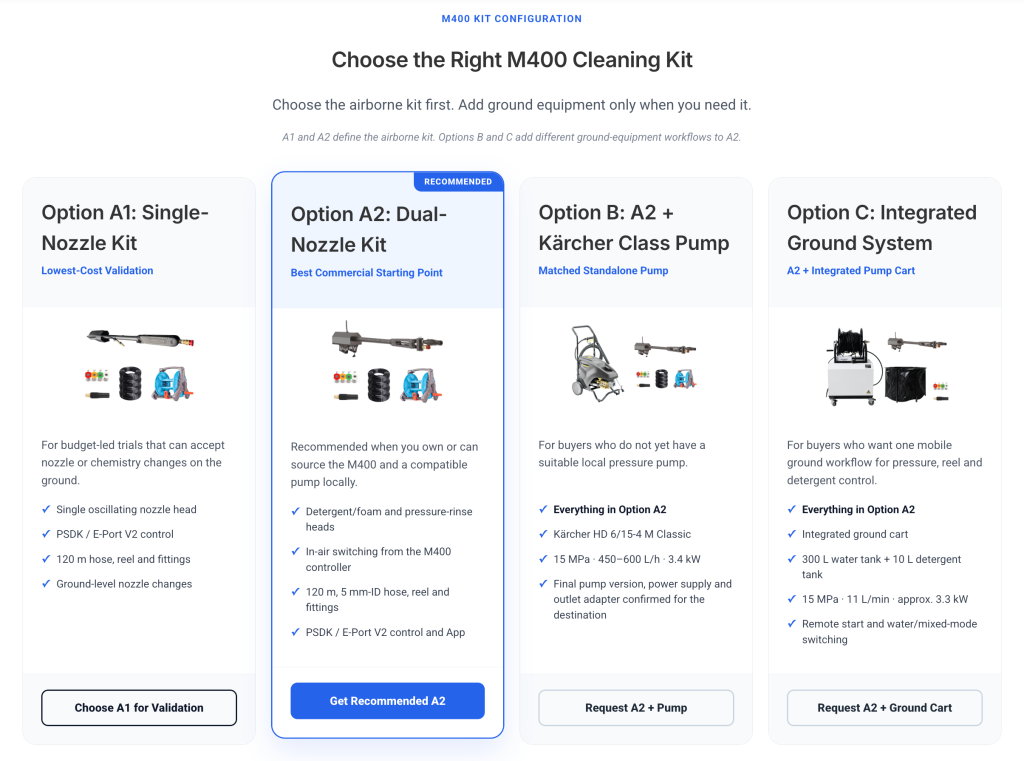
3. What are Option A1 and Option A2?
Option A1 and Option A2 define the core cleaning-kit workflow.
Option A1 — Single-Nozzle Kit
A1 is the lower-entry-cost route for technical trials and initial workflow validation. When the cleaning process requires another nozzle, the aircraft lands so the operator can change it manually.
A1 workflow: Foam → Land → Change Nozzle → Relaunch → Rinse
Option A2 — Dual-Nozzle Kit — Recommended
A2 provides two spray heads and allows the operator to select the active head from the M400 controller. This removes the landing required solely for a nozzle change and creates a smoother commercial workflow.
A2 airborne workflow: Foam → Select Spray Head on DJI Controller → Rinse
A2 spray-head selection does not automatically change the ground-side liquid source. The ground crew or compatible ground system must also change from cleaning solution to clean water where required.
4. What ground-pump choices are available?
There are three routes.
Existing or locally purchased pump
An initial screening baseline is:
- at least approximately 3 kW;
- adjustable 12–18 MPa;
- approximately 450–600 L/h.
Send the exact pump model, a clear nameplate photo, rated power, working and maximum pressure, flow rate and outlet photos. EAUAV engineering must confirm compatibility before the pump is connected to the cleaning kit.
Option B — A2 + matched standalone pump
Option B combines A2 with the Kärcher HD 6/15-4 M Classic.
Reference data:
- 70–150 bar adjustable working range;
- approximately 450–600 L/h;
- 3.4 kW.
The destination voltage, frequency, phase and plug/socket type must be confirmed before quotation.
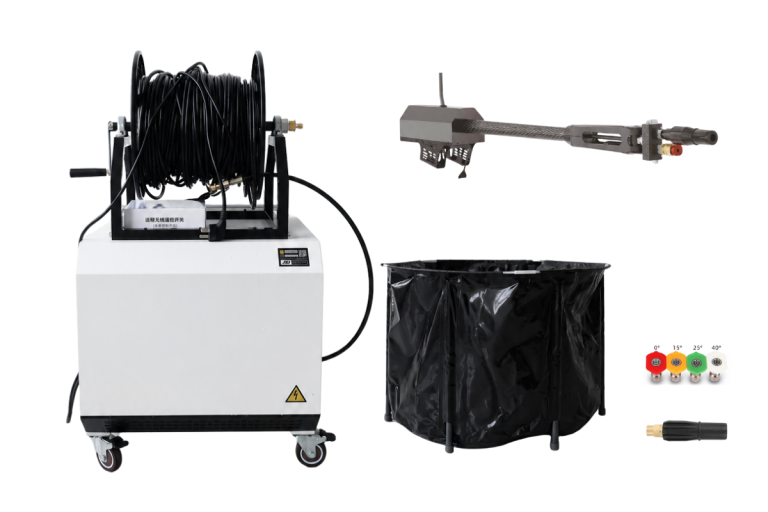
Option C — A2 + Gen-2 Integrated Ground System
Option C combines A2 with the white mobile integrated ground unit.
Current planning references include:
- up to 15 MPa;
- 11 L/min;
- approximately 3.3 kW;
- 300 L foldable water tank;
- 10 L detergent tank;
- integrated reel connection;
- remote start and water/mixed-mode selection.
Final electrical version, connections and control arrangement are confirmed for the destination.
5. What electrical information is required for Option B or C?
Before quotation, provide:
- destination voltage;
- frequency;
- single-phase or three-phase supply;
- plug or socket type;
- applicable grounding or electrical-protection requirements.
A clear photo of the intended site socket is useful when the plug standard is uncertain.
6. What hose is supplied?
The current standard reference is a 120 m lightweight high-pressure hose with:
- 5 mm internal diameter;
- 20 MPa pressure rating.
The final hose, reel and fitting combination is confirmed with the selected configuration.
7. Does a 120 m hose mean 120 m working height?
No. Hose length provides routing flexibility; it is not a guaranteed vertical cleaning height.
Routine M400 facade projects should currently be planned below 60 m, subject to pump setup, suspended hose length, hose route, pressure loss, wind, facade geometry, local operating rules and onsite validation.
8. Does the hose affect flight?
Yes. The crew must plan for:
- suspended hose length and drag;
- hose sway and wind;
- snag points;
- ground-crew position;
- pressure reaction;
- pedestrian exclusion zone;
- emergency pump shutdown;
- landing and return route.
Low-height validation should be completed before commercial operation.
9. How far should the spray boom be from the facade?
Begin testing at approximately 1.5 m from a flat facade. Adjust only after confirming the spray response, surface sensitivity and aircraft stability.
This is a starting reference, not a guaranteed distance for every nozzle, pressure and facade.
10. What nozzle options are available?
The current nozzle set includes foam, 0°, 15°, 25° and 40° patterns. Selection should consider:
- facade material and condition;
- coating, seal and joint sensitivity;
- desired coverage;
- pressure;
- stand-off distance;
- cleaning agent and process.
Always validate on a small area first.
11. Is higher pressure always better?
No. Excessive pressure can damage coatings, seals, joints, older facade materials or sensitive roof surfaces.
Start at lower pressure and increase only after onsite validation. Pressure at the pump is not necessarily the same as pressure at the nozzle after hose loss and configuration effects.
12. What is the oscillating spray function?
The spray boom supports approximately 30° oscillating movement for wider coverage. This can reduce the need to rotate the entire aircraft as frequently during a cleaning pass.
Actual operation still depends on facade shape, distance, wind and pilot technique.
13. Which option should most commercial buyers start with?
Option A2 is the recommended commercial starting point. It improves the foam-to-rinse nozzle workflow without requiring the buyer to purchase an EAUAV ground pump if a suitable pump can be sourced locally.
Choose Option B when the buyer also wants EAUAV to provide the matched Kärcher pump. Choose Option C when an integrated ground pump, reel and detergent workflow is required.
14. What battery setup should I plan?
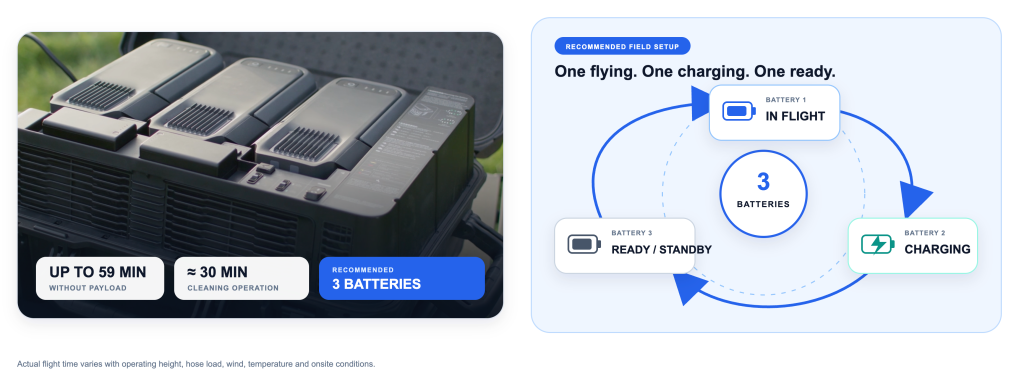
DJI publishes a maximum M400 flight time of up to 59 minutes under its specified test conditions carrying the H30T, without the cleaning setup.
For cleaning operations with the spray boom and water hose, use approximately 30 minutes per flight as the current planning reference. Actual endurance depends on wind, hose drag, suspended hose length, operating profile and battery condition.
Prepare three TB100 batteries and rotate them between:
- flight;
- charging;
- standby/cooling.
15. Does EAUAV supply RO/DI water or hot-water equipment?
Not currently. EAUAV does not supply a self-developed and validated RO/DI water-treatment or hot-water preparation system for this kit.
Customers should prepare these systems locally when low-mineral final rinsing or hot-water treatment is required. The site water source, temperature, flow, buffer arrangement and water quality must be confirmed for the project.
16. Does Option C supply cleaning chemicals?
Option C supports a detergent-mixing workflow, but cleaning chemicals are not automatically approved for every facade.
The customer or operator must confirm:
- cleaning-agent SDS;
- dilution ratio;
- surface compatibility;
- runoff and wastewater rules;
- local handling requirements;
- clean-water flushing after detergent use.
17. Can the kit clean solar panels or roofs?
The M400 Facade Cleaning Kit is not EAUAV’s recommended product for routine PV-panel cleaning. For solar-panel projects, evaluate the DJI Agras T100 Solar Cleaning Kit or Solaris C60V.
Selected roof-rinsing tasks may be discussed separately, subject to surface, flight geometry, runoff, hose route and site review.
18. What should I send before requesting a quote?
Send:
- whether you own or can source DJI Matrice 400 locally;
- country, city and postal code;
- target surface and building height;
- photos, drawings or video of the work area;
- indoor, outdoor or semi-indoor environment;
- preferred option: A1, A2, B, C or not sure;
- existing/local pump model and nameplate, if applicable;
- voltage, frequency, phase and plug/socket type for Option B or C;
- desired cleaning process: water, foam, detergent and/or final rinse;
- expected quantity and purchase timeline.
Quick Decision Table
| Buyer situation | Recommended starting route |
|---|---|
| Lowest-cost technical validation | Option A1 |
| Smoother commercial workflow with a local pump | Option A2 — Recommended |
| A2 plus an EAUAV-supplied matched pump | Option B |
| A2 plus an integrated mobile ground workflow | Option C |
| Existing or locally sourced pump | A1/A2 after engineering approval |
| Longer jobsite operation | Three TB100 batteries in rotation |
| Routine facade work above the M400 planning range | Compare C80/C80P and request site review |
Conclusion
The fastest way to avoid the wrong configuration is to separate three decisions:
- Choose A1 or recommended A2 for the airborne cleaning workflow.
- Choose an approved local pump, Option B or Option C for the ground system.
- Confirm the site, electrical supply, water process and three-battery plan before quotation.
Review the DJI M400 Facade Cleaning Kit.
Submit your location, preferred configuration and compatibility data for a quotation.